KlipLink vs Bitly: Which URL Shortener Is Better in 2026?
Compare KlipLink and Bitly in 2026. See which URL shortener offers better features, pricing, and performance for your needs.
Start Free on KlipLinkChoosing The Right Link Management Platform
If you’ve been researching URL shorteners, you’ve likely come across Bitly. For years, it’s been one of the most recognised tools for shortening links, tracking clicks, and managing campaigns at scale.
But the market has evolved.
Today, users expect more than simple short links. They want branded URLs, QR codes, analytics, landing pages, automation, and tools that help create smarter journeys across devices and regions.
As a result, Bitly is no longer the only major option.
KlipLink is one of several newer platforms challenging the traditional model. Rather than focusing only on enterprise users, it aims to make advanced link management tools accessible to creators, startups, agencies, and growing businesses.
At a surface level, both platforms look similar. They offer URL shortening, QR codes, landing pages, analytics, API access, and integrations. The key differences appear in pricing, usage limits, branded domains, and routing capabilities.
This comparison breaks down where each platform stands — and which one may be the better fit depending on your needs.
Quick Comparison: KlipLink vs Bitly
Both platforms cover the fundamentals of modern link management, but there are meaningful differences once you move beyond basic URL shortening.
| Feature | KlipLink View Pricing |
Bitly View Pricing |
|---|---|---|
| URL Shortening | Included | Included |
| QR Codes | Included | Included |
| Landing Pages | Included | Included |
| Analytics | Available | Available |
| API Access | Included | Included |
| Zapier Integration | Available | Available |
| Make Integration | Available | Available |
| Custom Domains on Free Plan | 1 Included | Not Included |
| Smart Link Routing & Conditional Redirects |
Dynamic Routes
Available from Starter plan Explore Benefits |
Not Available |
| Free Plan Ads | No Ads | Free-plan destination preview pages may include advertising. |
| Starting Paid Plan | $5.99/month | $10/month |
The biggest takeaway is that this isn't a comparison between a feature-rich platform and a limited platform. Both products offer most of the functionality modern users expect. The more important question is how much access you get to those features, how much flexibility they provide, and what you'll pay as your usage grows.
What Is Bitly?
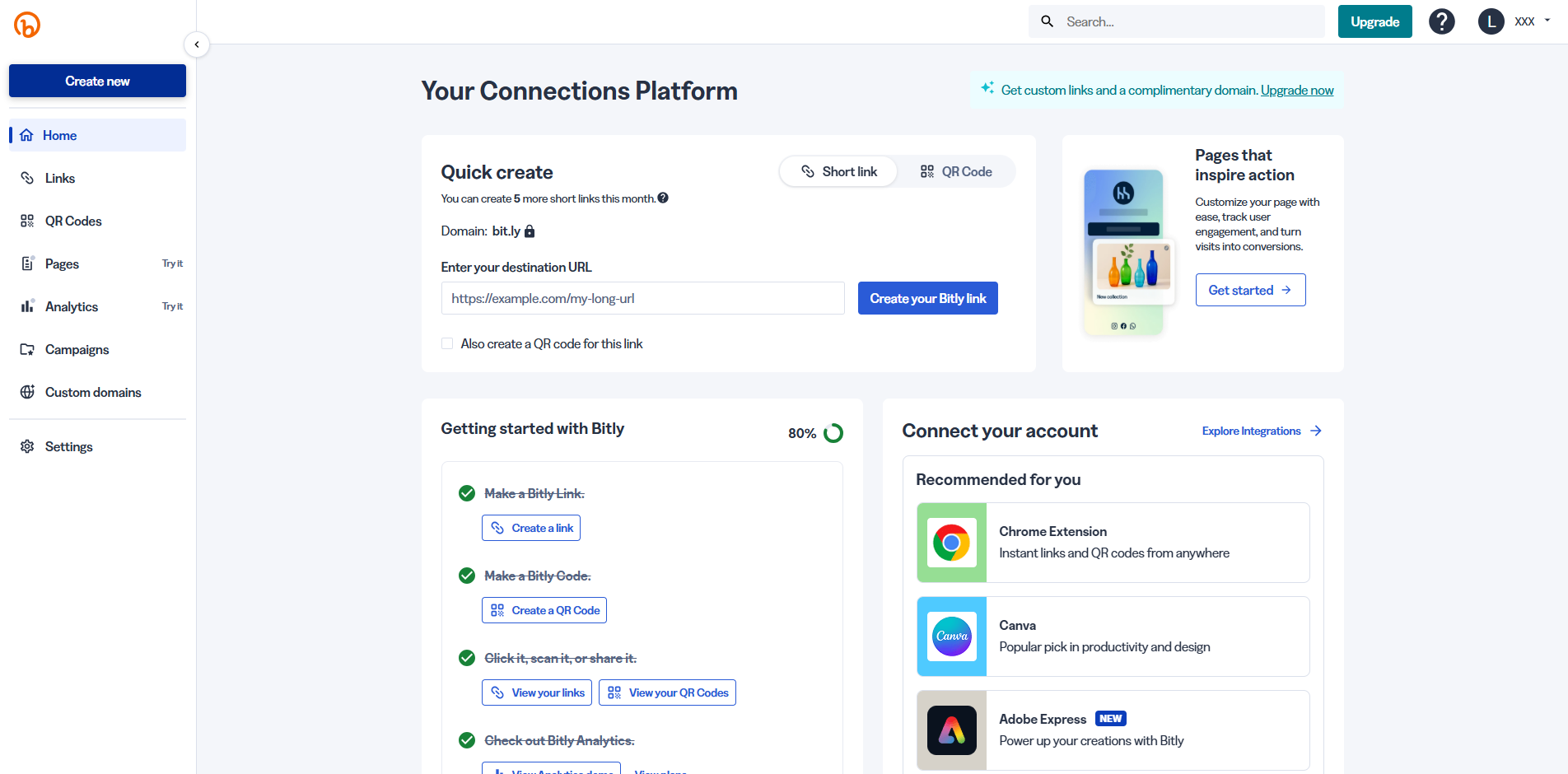
Founded in 2008, Bitly helped popularise URL shortening during the rise of social media. At a time when character limits mattered and long URLs looked messy on platforms like Twitter, Bitly became one of the internet's most widely used link shortening services.
Over the years, Bitly evolved far beyond simple short links. The platform now includes QR codes, landing pages, branded links, analytics, campaign management tools, integrations, and enterprise-grade infrastructure designed to support organisations operating at significant scale.
Today, Bitly serves a broad customer base ranging from individual creators to multinational brands.
Where Bitly Excels
- Brand Recognition: Bitly remains one of the most recognised names in the industry.
- Enterprise Features: Advanced analytics, team management, SSO, SLA guarantees, and enterprise security controls.
- Large Integration Ecosystem: Extensive integrations with marketing, CRM, and automation tools.
- Mature Infrastructure: Built to support high-volume link management and large organisations.
- Advanced Reporting: Longer analytics retention periods and deeper reporting options on higher plans.
Bitly's pricing and feature structure clearly indicate its focus on businesses and organisations that require scalability, compliance, and advanced reporting capabilities.
For larger companies, those enterprise-focused capabilities may justify the higher pricing. For smaller organisations, however, the value proposition becomes less straightforward when compared against newer competitors.
What Is KlipLink?
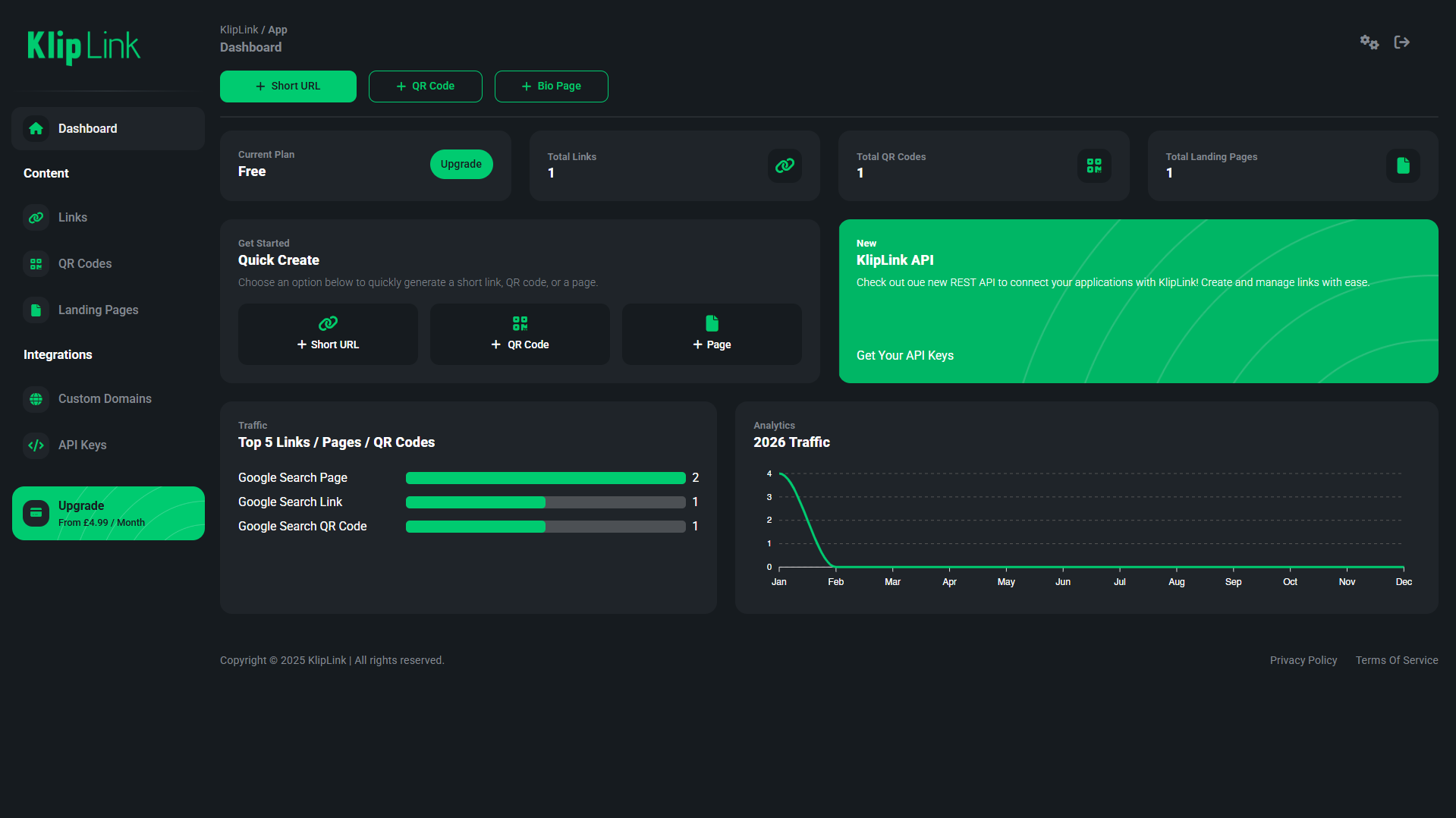
KlipLink is a modern link management platform that combines URL shortening, QR codes, landing pages, analytics, branded domains, automation, and Dynamic Routes within a single dashboard.
While Bitly's evolution has increasingly focused on enterprise customers, KlipLink has taken a different approach. The platform is designed to make advanced link management tools available to creators, startups, agencies, marketers, and growing businesses without requiring enterprise-level budgets.
Rather than positioning itself as simply a URL shortener, KlipLink aims to become a complete link infrastructure platform for digital campaigns.
Key KlipLink Features
- Short Links: Create branded or unbranded URLs in seconds.
- QR Codes: Generate trackable QR codes connected directly to your links.
- Landing Pages: Build link-in-bio style pages for social media profiles and campaigns.
- Analytics: Track clicks, devices, browsers, locations, and referral sources.
- Custom Domains: Connect your own branded domains across links, pages, QR codes, and Dynamic Routes.
- API Access: Automate workflows and build custom integrations.
- Zapier & Make Support: Connect KlipLink to thousands of third-party applications.
- Dynamic Routes: Route visitors based on device, operating system, location, browser, and custom conditions.
KlipLink's primary appeal isn't that it offers features Bitly lacks. Instead, it's that many of those features are available at lower pricing tiers and with more generous usage allowances.
Pricing Comparison
Pricing is arguably the most important distinction between the two platforms.
At a feature level, Bitly and KlipLink have more similarities than differences. The question many users ultimately ask isn't whether a feature exists — it's how much access they get before needing to upgrade.
This is where the comparison becomes particularly interesting.
Free Plans
Both KlipLink and Bitly offer a free plan with API access included. KlipLink's free tier includes 5 links, 2 QR codes, and 1 landing page per month, and lets you connect 1 custom domain. Bitly's free plan covers 5 links, 2 QR codes, and 2 landing pages per month, but doesn't let you connect a custom domain — meaning you'll need to upgrade before you can use your own branded URL.
Entry-Level Paid Plans
| Feature | KlipLink Starter ( $5.99 / month) | Bitly Core ( $10 / month*)
*Only available annually at $120/year |
|---|---|---|
| Links | 100 | 100 |
| QR Codes | 10 | 5 |
| Landing Pages | 5 | 5 |
| API Requests | 5,000 / month | 5,000 / month |
| Custom Domains | 2 included | 0 included |
| Dynamic Routes | Included | Not listed |
At the lower end of the market, the two platforms offer similar core allowances for links and API access. KlipLink's advantage comes primarily from including custom domains and additional QR code capacity at a lower monthly price.
Mid-Tier Plans
| Feature | KlipLink Core ( $14.99 / month) | Bitly Growth ($29 / month) |
|---|---|---|
| Links | 500 | 500 |
| QR Codes | 50 | 10 |
| Landing Pages | 25 | 10 |
| Custom Domains | 3 included | 1 included |
| API Requests | 10,000 / month | 25,000 / month |
| Dynamic Routes | Included | Not listed |
At this level, the difference in pricing becomes more noticeable. Bitly offers substantially higher API limits and access to branded links, while KlipLink provides significantly more QR codes, landing pages, and custom domains at roughly half the monthly cost.
Neither approach is inherently better. Businesses heavily reliant on APIs may prefer Bitly's higher limits, while marketers, creators, and agencies may find KlipLink's broader allowances more attractive.
The broader trend is clear: Bitly tends to focus on enterprise-oriented scalability, while KlipLink focuses on providing more resources and functionality at lower pricing tiers.
Start Free on KlipLinkCustom Domains and Branded Links
Custom domains are one of the most important features in any serious link management platform. They directly affect how your links look, how trustworthy they appear, and how consistently your brand is represented across campaigns.
A branded short link replaces a generic shortening domain with your own domain. Instead of a link like bit.ly/example, you might use links.yourbrand.com/example. This small change has a measurable impact on trust, click-through rates, and brand recognition.
In practice, branded links are especially valuable in email marketing, social media, influencer campaigns, and offline materials where users may be seeing your brand for the first time.
Bitly
Bitly supports branded links through custom domains, but this capability is typically tied to paid plans. For most users, branded domains become available starting at higher pricing tiers, depending on the plan structure at the time of use.
This makes Bitly a strong option for organisations that already have budget allocated for marketing infrastructure and are comfortable upgrading to access branding features.
KlipLink
KlipLink includes custom domain support from its free plan, allowing users to connect and use their own branded domain without needing to immediately upgrade.
This makes it significantly easier for smaller teams, creators, and startups to launch branded link campaigns from day one without upfront cost barriers.
Dynamic Routes: Intelligent Link Behaviour
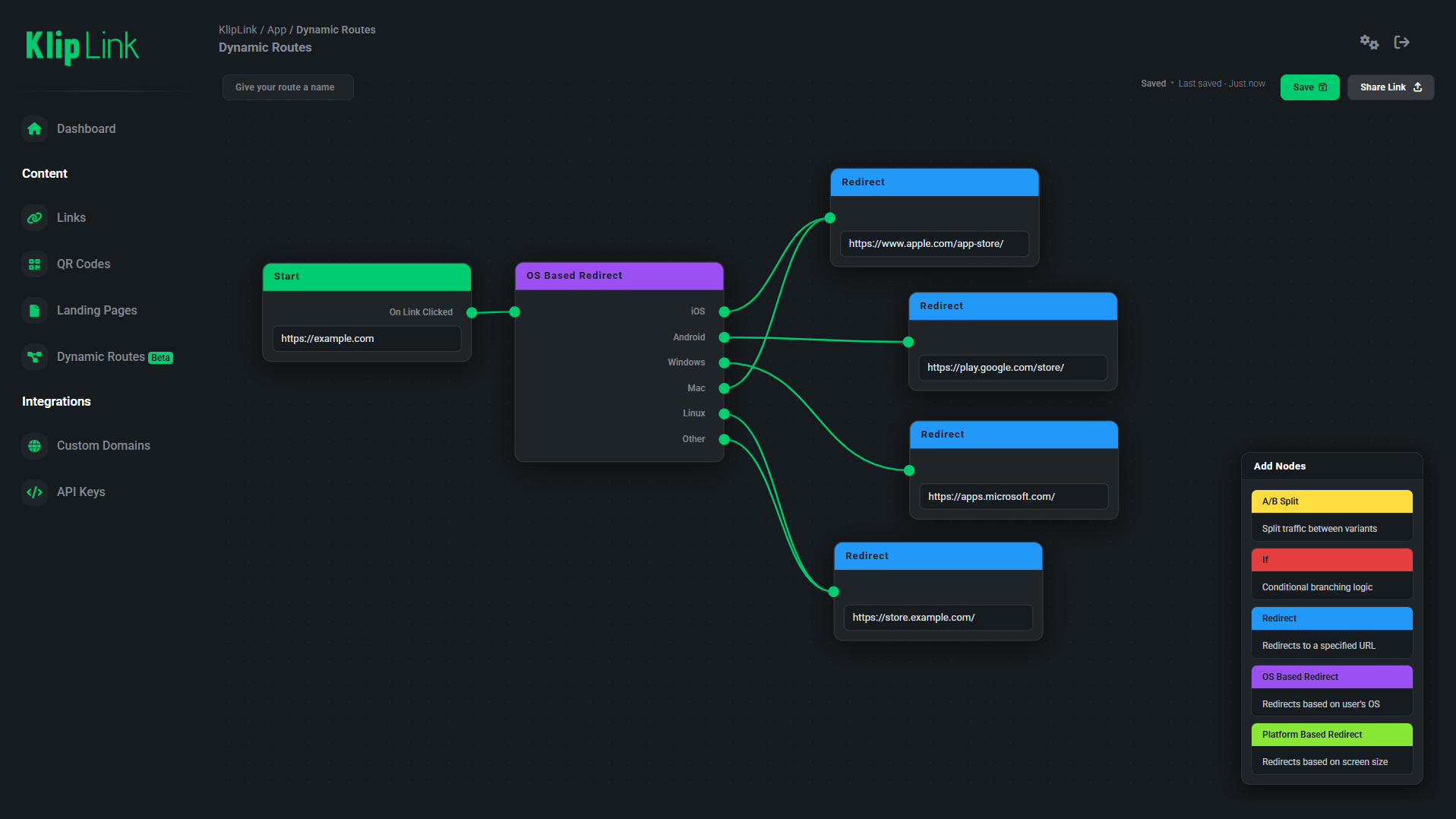
Dynamic Routes represent one of the clearest functional differentiators between KlipLink and traditional link shorteners.
While most link shorteners send every user to a single destination, Dynamic Routes allow links to behave differently depending on user context.
This includes factors such as device type, operating system, browser, and geographic location.
How Dynamic Routing Works
Instead of a static redirect, a single link can contain multiple destination rules as nodes, to create dynamic routing logic. When a user clicks the link, KlipLink evaluates the conditions and sends the user to the most appropriate destination automatically.
For example:
- iOS users can be sent to the App Store
- Android users can be sent to Google Play
- Desktop users can be sent to a web landing page
This eliminates the need to manage multiple links for the same campaign and ensures users always land on the most relevant destination.
Geographic Routing
Dynamic Routes can also be used for location-based targeting.
A single campaign link can send users in different countries to different storefronts, landing pages, or localized content.
This is particularly useful for:
- International e-commerce stores
- Global marketing campaigns
- Event pages with location-specific information
Bitly does not offer equivalent conditional routing. KlipLink consolidates these behaviours into a single node-based routing system designed specifically for flexible, efficient campaigns.
Analytics and Reporting
Both Bitly and KlipLink provide analytics, including click tracking, device information, and geographic insights.
These metrics form the foundation of any link management strategy, allowing users to understand where traffic is coming from and how audiences engage with their content.
Bitly
Bitly offers more advanced analytics features at higher tiers, including extended data retention, deeper reporting, and enterprise-grade dashboards designed for large-scale campaign analysis.
This makes it particularly well suited for organisations running high-volume marketing operations that require long-term data tracking and governance.
KlipLink
KlipLink provides built-in analytics across all link types, including short links, QR codes, and landing pages.
The focus is on accessibility and clarity, giving users a unified view of performance on all paid plans.
API Access and Automation
Automation is an essential part of modern marketing and product workflows.
Both platforms support API access and integrations with tools such as Zapier and Make, with the ability to start for free, enabling users to automate processes like link creation, QR code generation, and campaign tracking.
Bitly
Bitly offers a robust API and integration ecosystem, particularly suited to enterprise environments where large-scale automation and governance are required. API limits and advanced capabilities may vary depending on plan tier.
KlipLink
KlipLink also provides API access, allowing developers and teams to integrate link creation and management into their own systems without needing enterprise-level commitments.
This makes it especially appealing for startups and smaller teams building internal tools or early-stage products.
Where KlipLink Stands Out
While both platforms offer strong core functionality, KlipLink differentiates itself most clearly in areas related to flexibility and value distribution across pricing tiers.
- Dynamic Routes for device, location, and rule-based redirection
- Custom domains available from the free plan
- Higher QR code allowances across comparable pricing tiers
- More landing pages included on paid plans
- Lower cost of entry for creators, startups, and small businesses
- Ad-free experience on the free plan
These differences are less about replacing Bitly and more about offering a different pricing and product philosophy.
Which Platform Is Right For You?
If you're running a large enterprise with procurement processes, compliance requirements, and a dedicated marketing budget, Bitly's infrastructure is built for that environment.
For everyone else — creators, startups, agencies, and growing businesses — KlipLink gives you more for less. Custom domains from the free plan, Dynamic Routes from $5.99/month, more QR codes, more landing pages, and no annual lock-in.
Most users don't need enterprise tooling. They need something powerful, flexible, and affordable from day one.
Ready to Try KlipLink?
Create your free account today and start building branded links, QR codes, and smart redirects in minutes.
Final Verdict
Bitly and KlipLink are more similar today than most users expect. Both platforms provide URL shortening, QR codes, landing pages, analytics, automation, and API access.
The real difference lies in how those capabilities are packaged and priced.
Bitly is built for scale, governance, and enterprise environments where brand trust, compliance, and advanced reporting matter most.
KlipLink focuses on accessibility, offering more generous usage allowances, earlier access to custom domains, and advanced routing features at significantly lower entry costs.
Neither platform is objectively better in all cases. They simply serve different priorities.
For enterprise organisations, Bitly remains a proven and reliable solution.
For creators, startups, agencies, and growing businesses, KlipLink offers a compelling alternative that prioritises value, flexibility, and modern link management needs.
The best way to decide is simple: test both platforms with real campaigns and see which one fits your workflow better.